



In this guide for employers we will be exploring how the coronavirus pandemic will be impacting the wellbeing of employees as we adapt to a ‘new normal’.
Keep reading for practical tips on how to anticipate and respond to the negative impact on employee wellbeing like feelings of anxiety around coronavirus, and how to develop strategies to monitor and support employee engagement.
The impact of the coronavirus pandemic
The coronavirus pandemic has caused significant and ongoing health and safety concern, as well as economic damage. We have been forced to adapt in unprecedented ways, which has affected the way we work, socialise and carry out our daily lives.
In our ‘new normal’ at work, our policies have have had to be reviewed to reflect Covid-19 measures and more employees are working from home than ever before.
This series of events has and continues to have an impact on our lives. The uncertainty, continual change of circumstances and feeling of economic insecurity over the last few years is likely to have caused a knock on effect to employee mental health. As a result this will be impacting engagement towards job roles and the workplace.
For this reason, it is crucial that organisations are agile and we remain mindful of the possible impact that lockdowns and transitioning through varying levels of restrictions in the ‘new normal’ may have had on engagement levels. This will enable us to anticipate and respond appropriately and responsibly to employee health and wellbeing concerns.
Four causes of anxiety in relation to coronavirus
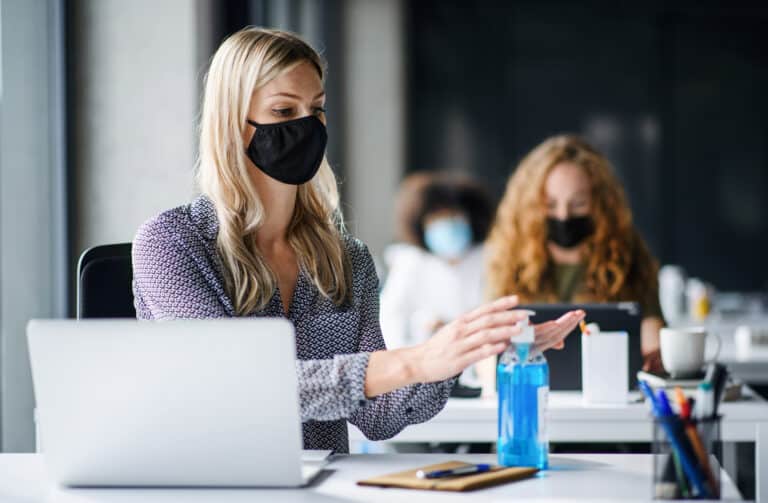
A feeling of anxiety has been defined as the feeling of worry, fear or unease. As we progress through the coronavirus pandemic it is likely that employees may have been experiencing these kinds of feelings to various extents.
What aspects of the ‘new normal’ may be having a negative impact on employee wellbeing and causing feelings of anxiety?
1. Choices
There are now more options around working schedules, including working from home, working from the office, hybrid-working models, working on a rota basis or full time, and temporary working patterns. All of these options require mutual agreement between the employer and employee to maintain a positive working relationship and, therefore, provides scope for some tension.
Employees are also continuing to have to weigh up risk in their personal lives and try to agree ways to adapt their working schedules with their employers to meet their own responsibilities. For example, this may be in relation to childcare or looking after elderly relatives who may be clinically vulnerable.
2. Health and safety concerns
Alongside the choices around working and personal lives that we are having to continue to make as we progress through the new normal, individuals may have concerns around the health and safety risk posed by coronavirus, especially when coronavirus cases are high. This may be in the workplace, commuting, or going about our daily lives. Individuals may have feelings of anxiety about catching the virus themselves or spreading the virus to vulnerable family, friends or colleagues.
As a result, employees will require more reassurance around the health and safety measures that their employers have put in place to protect them.
3. Job security
In 2020, the Bank of England expected the UK economy to shrink by 9.5%, which would represent the largest annual decline in 100 years, with unemployment expected to rise significantly (BBC News, 2020). A number of government schemes have offered support to retain jobs, such as the Coronavirus Job Retention Scheme which ended in September 2021.
More and more organisations are having to resort to cost cutting methods, primarily redundancies, in order to remain commercially viable, with very few industries left untouched. This significant impact on the UK economy and the labour market may have a negative impact on employee wellbeing, as individuals have concern around their own job security and the performance of their employer.
Employees may be aware of redundancies having been made already in their organisation and fear they may be the next ones at risk. This generates increasing concerns around their own financial wellbeing.
4. Guilt
Individuals may also be feeling a level of guilt, which in turn has a negative impact on employee wellbeing. They may have guilt around being on furlough leave whilst their colleagues have been working through challenging times.
Equally, they may be experiencing guilt if they were not placed on furlough leave and have continued to work. Similarly, individuals who have not been made redundant, so-called ‘survivors’, may feel guilt whilst their colleagues may have been made redundant. Equally, sometimes, those who have been made redundant may feel guilt, especially if they received a sizeable redundancy payment and the future of the organisation appears uncertain.
The impact of anxiety on employee behaviour

It is important to remain mindful of how these concerns can impact employee wellbeing and therefore affect behaviour amongst the team. Individuals will manage challenges and uncertainty in different ways, and, as a consequence, their levels of engagement may go through peaks and troughs as we progress through the new normal.
Warning signs of an employee impacted by anxiety
Therefore, it is advisable that managers are made aware of the warning signs to look out for, which indicate that an employee’s wellbeing has been negatively impacted:
- Requesting more time off work
- Over-reacting to what others say, in a way that is different to usual
- Talking more negatively and dwelling on negative experiences
- Struggling to maintain concentration
- Restlessness
- A drop in their level of performance
- A drop in their level of attendance
Consequences for employee engagement
The above consequences of affected employee wellbeing are likely to impact on their engagement in their role and the organisation. Moreover, it is suggested that, if an employee felt disengaged prior to the pandemic, this will become even more apparent now.
This can have significant consequences for individual behaviour, performance and, in turn, overall organisational performance. Therefore it is crucial that these signs are identified and addressed as soon as possible, especially when the majority of organisations are being pushed to their limits.
Practical tips for anticipating and responding to employee anxiety
The most effective measure is to take a preventative approach and anticipate the impact of the current challenges and changes in the external environment on employees. This will enable us to help employees in a proactive way.
Therefore, we have included six tips below for anticipating when an employee’s wellbeing has been negatively impacted by coronavirus concerns, before we explore ways to respond.
Five tips for anticipating employee anxiety

1. Create a safe environment to share concerns
Keep the conversation open with employees and ensure they feel they have a safe space to share concerns and comments. This could be in regular one to ones or just ensuring that employees know who they can speak to when they have a concern. Ask ‘how are you’ but then probe into the answer, particularly if any unusual behaviour has been noticed.
2. Maintain regular contact
Whilst the workforce may continue to work on different working patterns or working from home, it is important to retain regular contact with employees even if managers don’t often see them face to face. Ensure one to ones with those working from home and ensure they feel included in the business and able to share their concerns also.
3. Communicate Health and Safety measures
Ensure clear communication around the health and safety measures that the organisation has put in place and any risk assessments that have been carried out in relation to COVID-19. This could be in the form of emails, telephone calls, posters or regular conversations with staff to appease any concerns they may have in this area.
4. Communicate business updates transparently
Maintain transparency regarding how the business is doing, organisational performance, business planning and strategy, as much as possible. This will help employees to understand their business environment and how it may impact them. This transparency could be through virtual townhalls or team meetings, and employees should have the opportunity to ask any questions they may have.
5. Be a visible leader
Promote leadership visibility so that employees can look to the leaders as role models to inspire the workforce.
Four ways to respond to employee anxiety and behaviour

Whilst putting in place measures to anticipate feelings of anxiety and its negative impact on wellbeing, behaviour and engagement is crucial, it will not always mean that it is completely prevented. Therefore, where a manager spots a warning sign, it is important to respond in an appropriate manner.
Here are four ways managers can respond to concerns about employee wellbeing in the ‘new normal’:
1. Initiate a dialogue around concerning behaviour
Initiate a dialogue with the individual and refer to a recent example of behaviour which was concerning and invite them to share how they are doing.
2. Demonstrate approachability
Listen, understand, demonstrate approachability, and show empathy. These will be important tools during these conversations.
3. Show vulnerability
Show vulnerability and share some of your own experiences, whilst being careful not to dominate the conversation.
4. Signpost mental health support offered by company
Place importance on any mental health support that is offered by the organisation, such as an employee assistance program, and encourage its use, providing key details.
5. Support managers to anticipate and respond
Managers will play a key role in remaining aware of the warning signs, as well as anticipating and responding to them. Therefore, it is important to consider whether managers are prepared for this role and to manage these conversations. Put in place additional training or support to guide them if required.
Employer duty of care: the legal implications
Whilst effectively supporting employees is important for employee engagement and organisational performance, it is also necessary to avoid any legal risk. Employers have a duty of care to employees and this is particularly relevant in the new normal as we navigate a challenging and changing environment. As employers, we must put in place the necessary safety measures, initiatives and approaches to demonstrate this duty of care, with the goal of minimising and avoiding any tension or disputes.
In turn, this will help to promote trust and confidence in the employment relationship.
The importance of psychological safety at work
The term of ‘psychological safety’ was coined by Amy Edmondson, a Professor in Leadership at Harvard University, in her book ‘The Fearless organization’. Amy states that high organisational and individual performance can only be possible through openness, flexibility and interdependence.
Importantly, she says this relies upon a psychologically safe environment. This term is about employees having the confidence to raise concerns without fear that their line manager or colleagues will reject, punish or embarrass them.
Moreover, a study recently carried out by Google has demonstrated that an individual’s psychological safety is imperative to their level of engagement. Therefore, cultivating psychological safety should be a priority for organisations as we progress through the new normal.
An organisational culture of safety is one in which mutual trust and respect is the norm. Employees feel able and comfortable to share their anxieties and thoughts. This enables employers to effectively tailor their support to the employee’s specific needs and in a timely manner, before any issues are exacerbated.
Aligning strategy to psychological safety
Psychological safety should be embedded in the culture of an organisation, alongside values and a focus on employee wellbeing. This is especially important in the era of a pandemic as safety is paramount. In light of this we recommend that organisations view this as an opportunity to review their current strategy.
Consider how working practices could be amended to support employee wellbeing and achieve organisational objectives. The pandemic and the situation of the new normal has shone a light on the fact that people are at the centre of the business agenda, so their wellbeing, psychological safety and how they are treated is paramount to organisational success.
Now is the time to consider whether your current company policies need updating to reflect new ways of working. Perhaps you need to update or implement a home working policy, or a coronavirus policy to guide behaviour and wellbeing during the pandemic? It is also an important time to promote flexibility and inclusion, as well as increase focus on health and wellbeing, and fair and responsible treatment.
Reviewing these elements of organisational strategy and the policies currently in place will be important to place companies at the forefront and support the achievement of organisational objectives.
Monitoring employee engagement

As we have established, there are effective initiatives and approaches that employers can take to support employees in managing their anxieties around the new normal and engage them in their roles and the organisation.
However, it is important that the measures that are being put in place are targeted, rather than a scattered approach. Moreover, it is important to monitor how employee engagement is being impacted by the measures you put in place, in order to measure efficacy.
You could choose to take regular temperature checks on employee engagement using quick and informal pulse surveys, through one to one feedback and also through team catch ups, which the manager can feed back on to a central party.
You could also measure employees’ feelings around the pandemic and the employer’s approach to protecting health and safety in this regard by sending out a survey on this topic. In particular, ask employees how they feel about their role in the new normal, remote working, leadership and the support available to support their wellbeing.
This will help us to understand if any of our initiatives aren’t quite having the desired impact and if we could do anything differently to enhance their efficacy.
These metrics will support organisations in demonstrating the value from aligning their strategy to psychological safety and wellbeing. This may be especially important when putting together a business case to enhance measures in this area.
Employee Engagement in the ‘new normal’
To sum up, we are moving through an uncertain time and continue to face new challenges along the way. As employers, we have a duty of care to support our employees. Employers have gone to great lengths to adapt their places of work to protect the physical health and safety of our employees during the pandemic.
We must be also mindful of the impact that the pandemic can have on the psychological wellbeing of our employees. We can take proactive steps to anticipate, and respond appropriately when employees exhibit signs of negatively impacted wellbeing. This will help to create an environment of psychological safety at work, and support employee engagement.
If you have any questions on this topic you would like to discuss, please contact our team.